03 May 2024 Customer Experience Metrics: NPS (Net Promoter Score)

You have probably heard of NPS, one of the many metrics used to measure customer experience. Also known as Net Promoter Score, NPS plays a key role in helping successful companies measure and improve customer loyalty. In this article, we will explore why tracking NPS matters and how it is used.

First introduced in 2003, Frederick F. Reichheld, a partner at Bain & Company, presented a new method for evaluating how well companies manage loyalty-based relationships with their customers in a Harvard Business Review article and he named this metric the Net Promoter Score (NPS). In 2011, he published "The Ultimate Question 2.0", explaining how NPS evolved into a comprehensive management system that delivers strong financial and competitive results.

Before releasing the method, Frederick F. Reichheld and his team tested a series of questions to assess how well survey responses aligned with actual customer behaviour. They looked for correlations between answers and actions (such as repeat purchases or referrals to friends and family) that could drive profitable growth Based on data from 4,000 consumers, various survey questions were ranked according to their ability to predict the desired behaviour. The goal was to identify the most effective question for estimating customer lifetime value, and the NPS question proved to be the strongest predictor. Since its introduction, NPS has become a key metric for measuring customer satisfaction and loyalty.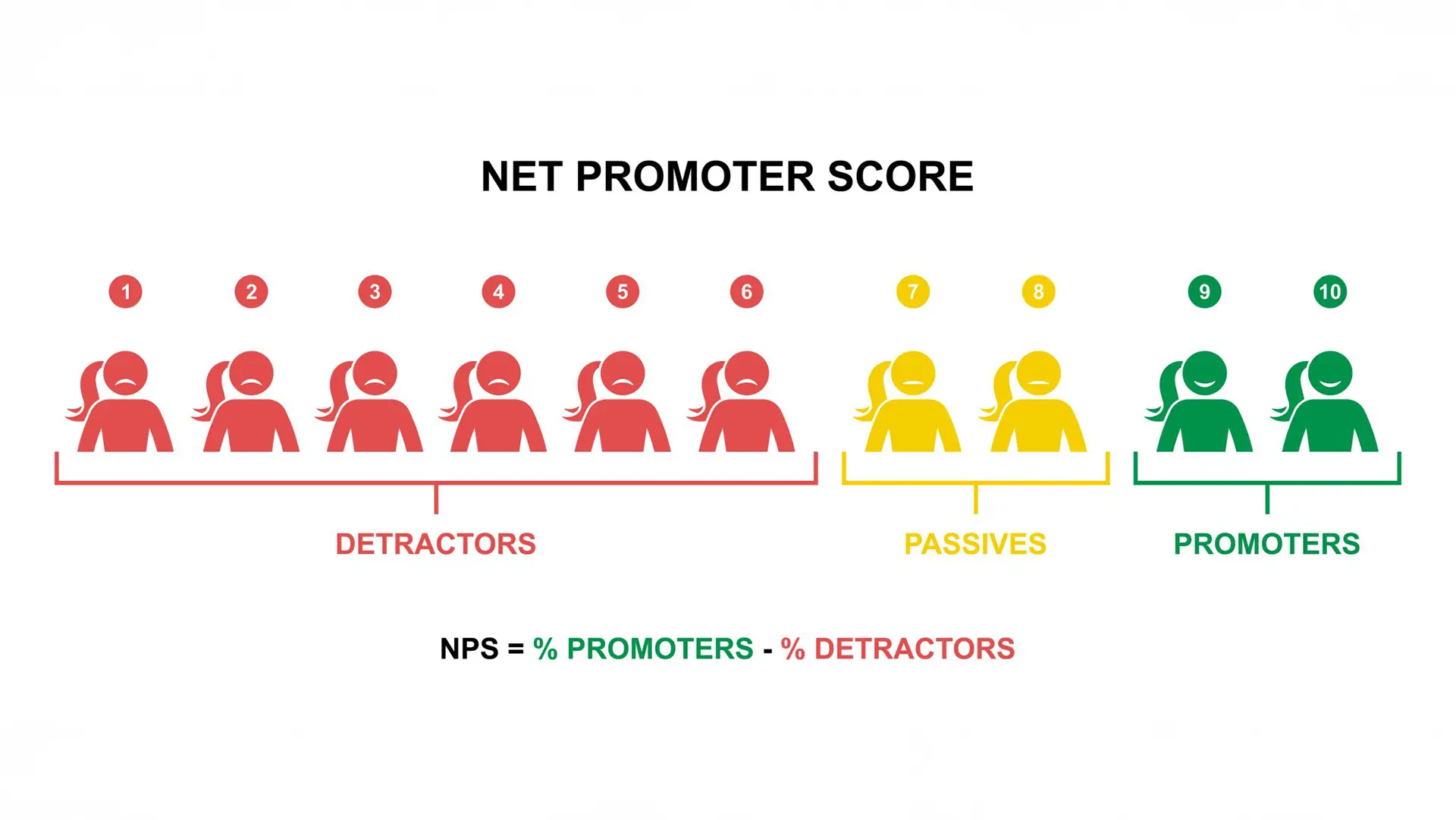
What Is NPS and How Is It Applied?
In short, NPS measures the likelihood of customers recommending a brand or company to others. It is typically assessed through a simple, single-question survey: “On a scale of 0–10, how likely are you to recommend our company or services?” This approach enables companies to gauge customer satisfaction without conducting a large-scale survey. (Of course, NPS can also be paired with additional questions or included in a broader customer feedback survey.)
According to the results, customers who rate between 0 and 6 are defined as "Detractors", those who rate between 7 and 8 are defined as "Passives", and those who rate between 9 and 10 are defined as "Promoters". The NPS score is calculated by subtracting the percentage of detractors from the percentage of promoters, and this score measures customer loyalty. However, the results are measured on a scale ranging from -100 to +100.
Any score above zero can be considered good, while a score above +50 is very good and a score above +70 is considered excellent.
Each of these customer groups is important for the company's growth and may require a specific action plan. Therefore, getting to know our customers well is the first step that must be taken.

Negative reviewers raise a red flag; if swift action is not taken, they will inevitably spread their dissatisfaction to others, damaging the company's reputation and future sales.. Therefore, it is extremely important to engage with negative reviewers to understand the reasons behind their low ratings, win them over, and make any possible corrections

Whilst passive customers may not be as vocal as detractors, they are customers who have not developed loyalty and are therefore easily lost to competitors. Recognising this, identifying who the passive customers are and incorporating the necessary adjustments into our processes to enable them to move into the advocates category is crucial for increasing our retention rate. Remember, the absence of complaints does not mean your customers are happy. 
Promoters are satisfied and loyal customers. Loyal customers return frequently, are willing to purchase additional products/services, recommend you to their friends, have lower service costs, and are less price sensitive. However, it would be misleading to take this for granted, and that is why it is crucial to keep this customer group, which yields the greatest returns, happy.
Why Should We Conduct Regular NPS Surveys?
Research indicates that the vast majority of consumers place greater importance on recommendations from their immediate circle than on advertisements. In fact, it demonstrates how effective this approach, which we often carry out in a conversational manner without realising it, is for companies' sales.
• It is simple. It is safe and encouraging for customers; people are generally willing to rate the service they receive, which is why NPS surveys have high response rates.
• NPS helps you predict growth.
• Regular NPS measurements allow us to track our customer satisfaction levels and facilitate the identification of areas for improvement.
• NPS enables us to take action. It can help us identify our weak areas and initiate change processes within our company based on customer feedback.
• It can be adapted for use at various touchpoints along the Customer Journey.
• Additionally, you can use NPS not only for products and services but also for employee surveys and many other areas. For instance: "Would you recommend working at X company to your friends and family?" Can you rate it between 0 and 10?
The most important thing in NPS is monitoring. By regularly monitoring NPS, you can ensure that people recommend your product or service to everyone or discover new business opportunities and product features that you had not thought of.
A few tips to improve our NPS response rate:
NPS measurement builds customer loyalty in the long term and its positive impact on sales is undeniable. However, critical points that require attention in its implementation and monitoring should not be overlooked. A loyal fan base will inevitably follow with proper implementation and monitoring. It should be remembered that no company can sustain growth in the long term without building strong relationships.
1. Segment your target audience. Try sending surveys to different touchpoints in the customer journey a few weeks or months later.
2. Personalise your follow-up questions. Create different questions for different customer types: detractors, passives, and promoters.
3. Keep questions simple. Use easy-to-understand language that everyone can respond to quickly and easily.
4. Keep the survey as short as possible. Try to limit this to a rating question and an open-ended question to keep people engaged and complete the survey.
5. Avoid biased or leading questions that could unfairly skew the survey results positively. Sometimes even the tone of voice used by the interviewer when asking the question can cause misdirection. It should be remembered that an inflated positive score is more harmful than a low NPS score.
6. Ensure accuracy and impartiality through verification.

In summary, although NPS is a simple survey that serves as the "ultimate question" on the path to growth, its benefits can yield meaningful results when tracked regularly. Undoubtedly, it is no coincidence that NPS continues to be popular, despite being just one of many metrics used by successful companies to measure customer satisfaction.